
Our Journey,
One Word at a Time
growth, impact, and vision for the future.

The History of Nkanda

Nkanda formerly (The AFLANG Project) was born out of a profound vision to preserve and promote African languages in a rapidly globalizing world. Philip Tete Akoda, its Founder and CEO, and Mary-Brenda Akoda, its Co-founder and CTO established Nkanda with a singular purpose: to preserve and promote Africa’s rich linguistic heritage in a world where globalization threatens cultural diversity. The inspiration for Nkanda came from Philip’s passion for African languages and his recognition of the urgent need for technological tools to document, learn, and celebrate them.
A prolific lexicographer, author, and cultural advocate, Philip envisioned Nkanda as a beacon for cultural preservation. Together with Mary-Brenda, a seasoned software engineer, AI researcher, and former Microsoft professional, the duo combined their expertise to create a groundbreaking EdTech platform.
Journey from Our Early Beginings
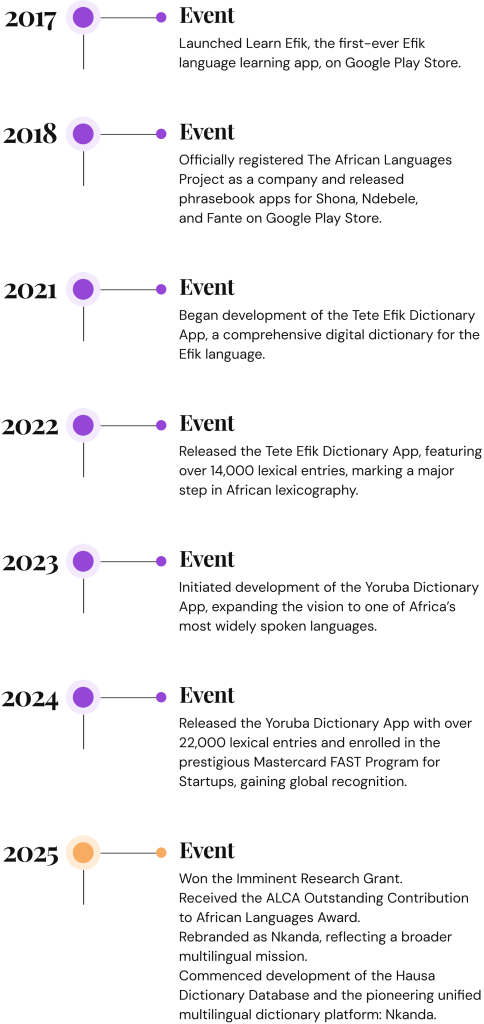
Nkanda’s premiere mobile apps were a series of phrasebook apps aimed at helping tourists navigate African languages. These phrasebooks apps published in 2017 were focused on languages such as Ndebele, Fante, and Oromo. These apps were built in collaboration with faculty members in universities such as: Addis Ababa University, Ethiopia; University of Cape Coast, Ghana; and University of Zimbabwe. These apps provided foundational tools for understanding basic phrases and cultural nuances, laying the groundwork for more ambitious projects.
Our Lexicographical Journey
Discover how we enrich your learning journey, connect you to your roots, and fit perfectly into your everyday life.
Tete Efik Dictionary App
The first bilingual dictionary for Nkanda was the Tete Efik Dictionary App, named after the project’s initiator, Tete. Published on the App Store and Google Play Store on March 2, 2022, the app contained a robust database of 14,400 words, making it the first comprehensive dictionary app ever developed for an African language.
The app provides far more than definitions. It includes audio recordings by native speakers, synonyms, antonyms, phonemic transcriptions, origins, historical usage, etymologies, and contextual sentence examples. This combination transformed it into not just a dictionary, but also a research and learning tool for linguists, historians, anthropologists, educators, translators, writers, dramatists, and everyday learners. A Word of the Day feature and carefully curated phrases further enhanced its accessibility for novices.
Development of the app spanned about a year. Its bilingual structure—Efik–English and English–Efik—was built on extensive research, drawing on classic resources such as Rev. Hugh Goldie’s dictionaries (1862, 1886), Robert Frederick G. Adams’ works (1952, 1953, 1981), Chief Effiong Ukpong Aye’s Efik-English Dictionary (1991), and the Efik Bible. Additional input from living speakers ensured the database reflected both historical depth and contemporary usage.
The project was powered by a dedicated technical team. Philip, the developer, coordinated the effort and personally entered all 4,400 Efik–English words into the database—a process that spanned several months. He also designed the logo, which integrates a book (symbolizing knowledge), the traditional Efik crown (ntinya), and the English crown, representing the revered Efik monarchy and bilingual identity. The app’s interface, enriched with Nsibidi symbols, was also his concept. Philip further expanded the dictionary by adding words absent from earlier works, generating synonyms and antonyms, and researching the origin and etymology of Efik words, thereby enriching the cultural and historical dimension of the resource.
The audio recordings—produced by Barr. Timothy Esu and Ani Ukpong—were painstakingly recorded and edited over several months at Strategy Beats Studio, Calabar. Ani also collaborated with Etim Effanga, Bassey Emmanuel, and Glory Echeng to input over 10,000 English–Efik entries into the database. Ita Bassey, a linguist, meticulously developed the phonemic transcriptions to ensure accurate pronunciation.
Field interviews with Efik speakers were also essential to validate meanings and confirm usage, with invaluable assistance from Engr. Esien-Ekpe.
Prof. Winifred Eyoanwan Akoda, Professor of History at the University of Calabar, provided Efik translations, offered corrections, suggested improvements, and even contributed to the app’s color scheme. Mary-Brenda Akoda offered IT guidance, while Mr. Nya Offiong and Mr. Eyo Akak supported the technical development.
Given its scale, the project required significant financial investment. Generous contributions came from the Efik diaspora, including the Efik Community in the USA and the Calabar Union, UK. Notable supporters include Mr. Ekpenyong Eyo, Mr. Emmanuel Nsemo, Dr. Sandy-Asari Hogan, Mr. Nya Offiong (Canada), Dr. Eyo Inameti, Chief Emmanuel Marshall, and Asandia Hogan. In Nigeria, further backing was provided by **Magnus Ekpiken, Reginald Yves-Bassey, and Ekei Duke.
The Tete Efik Dictionary App stands as a landmark achievement in African language technology, a fusion of scholarship, technology, and community effort that preserves and promotes the Efik language in the digital age.
Yoruba Dictionary App
Nkanda’s next major milestone was the launch of the Yoruba Dictionary App on September 27, 2024. Originally produced under the auspices of The African Languages Project (Now Nkanda), the Yoruba Dictionary App was available on the Google Play Store and the App Store on 27th September 2024. Consisting of over 22,000 words in its database, the Yoruba Dictionary App is a major milestone in our efforts to preserve, promote, and celebrate African languages. The dictionary includes words and their definitions, synonyms, antonyms, hypernyms, hyponyms, keywords, phonemic transcription, origin, history and etymology of words, inaugural word usage, real-life sentence examples, audio by indigenous speakers, and dialectical variations. Furthermore, what sets this app apart is its array of captivating games and badges designed to entertain and facilitate the learning of the Yorùbá language.
This dictionary app took one year and three months to develop. The audio recordings for the project were completed in 10 months at Truetalentz Media, Off Awolowo, Ikeja, Lagos, Nigeria. The dictionary is divided into Yoruba-English and English-Yoruba sections to accommodate both speakers and non-speakers of the language. This app is an excellent resource for researchers, academics (especially linguists, historians, and anthropologists), filmmakers, church translators, aspiring writers, dramatists, playwrights, authors, school teachers, students, and anyone captivated by the beauty of Yorùbá. With an estimated 57 million Yorùbá speakers, the Yoruba Dictionary App provides access to the rich and diverse world of the Yorùbá language.
As Chief lexicographer, Philip Akoda brought his expertise to the Yoruba Dictionary App. He was involved in several aspects of the app’s production, from data gathering and entry, meticulously inputting words into the database alongside the database entry team; to overseeing audio production at the studio, designing the app’s logo, designing questions for the games, and coordinating the various teams working on the project.
As Co-founder and CTO, Mary-Brenda Akoda was responsible for the development of the Yoruba Dictionary App, Mary-Brenda was especially keen on including games, badges, and a Yorùbá words’ recommendation feature as novel additions to the app to make it more engaging and exciting for users.
Prof. Winifred Eyoanwan Akoda is Nkanda’s Chief Research Officer (CRO). For the Yoruba Dictionary App, Prof. Wini was responsible for gathering data on the 12 Yorùbá dialects, with the help of academics in Nigeria and the U.S., to enrich the app.
Before the app’s production, several resource persons were consulted, particularly senior academics of Yorùbá heritage at the University of Ibadan, University of Lagos, Lagos State University, Ojo, and University of Ilorin in Nigeria. Consequently, and in alphabetical order of name, we recognise the encouragement and assistance of the following esteemed individuals to whom we owe our sincere gratitude:
• Dr. Abisoye Eleṣin, Research Fellow at the Institute of African and Diaspora Studies, University of Lagos.
• Prof. Ayo Yusuff, Institute of African and Diaspora Studies, University of Lagos.
• Prof. Bolanle Arokoyo, Head of the Department of Linguistics and Nigerian Languages, University of Ilorin. Prof. Arokoyo is credited with providing dialectical variations for Olukunmi and Owe dialects, as well as providing a copy of the “English-Yorùbá Glossary of HIV, AIDS and Ebola-related terms” to enhance the scientific data of the dictionary.
• Prof. Comfort Adamu (rtd), Federal University of Abeokuta.
• Mrs. Elizabeth Nike Ajayi (rtd), Adeniran Ogunsanya COE (now Lagos State University of Education.
• Prof. Ezekiel Dele Adeoti, Department of History and International Studies, Lagos State University, Ojo.
• Mr. Oyewole Olomu, Lecturer, Department of Linguistics, African Languages and Communication Arts, and Coordinator, Yoruba Language Studies, Lagos State University, Ojo. Mr. Olomu is credited with providing dialectical variations for Ekiti, Owo, Awori, and Egba dialects.
• Prof. Simon Ademola Ajayi, Department of History, University of Ibadan.
• Prof. Solomon Wole Oyetade, Dean of Arts and Professor at the Department of Linguistics and African Languages, University of Ibadan.
We also deeply appreciate the following graduates and students from the Departments of Linguistics/Yoruba and Education/Yoruba at University of Lagos (UNILAG), Obafemi Awolowo University, Osun State University, Kogi State University, and Ladoke Akintola University, Oyo State in Nigeria, all of whom were committed to this project and tirelessly contributed to the data entry:
• Adepoju Olanrewaju, BSc., Ladoke Akintola University, Oyo State.
• Anuoluwapo Olomolatan, B.A. Linguistics/Yoruba, UNILAG.
• Awokunle Olayinka Tope, B.A. Linguistics and Communication, Osun State University.
• Bello Ahmed Adedapo, B.A. History and Diplomatic Studies, Obafemi Awolowo University, Ile-Ife.
• Daud Olamide Abolade, Department of Linguistics, African and Asian Studies, UNILAG.
– Dorcas Abidemi Omolade, B.A. Linguistics/Yoruba, UNILAG.
• Eniola Julius, B.A. Linguistics/Yoruba, UNILAG.
• Kaosarat Alarape, B.A. Linguistics/Yoruba, UNILAG.
• Ololade Ajayi, B.A. Linguistics/Yoruba, UNILAG.
• Omobolaji Elizabeth Olusoji, B.A. Linguistics/Yoruba, UNILAG.
• Sikiru Jamiu Olawale, Department of Education/Yoruba, UNILAG.
• Yusuf Oluwaseun Gbolahan, Department of Linguistics, African and Asian Studies, UNILAG.
Mr. Evans Olugbenga Abdul and Mr. David O. Fafiyebi are credited with the voiceover for the app.
The non-Yorùbá speakers who assisted in the data entry for the English language section of the app include Ani Ani Ukpong, Eyo Eyo-Nsa, and Nnanke Eno Ikpi. Additionally, those who provided technical support include Bright Agu, Eyo Akak, and Larry Offiong.
Finally, in addition to oral sources, several Yorùbá dictionaries and books were consulted for this research, including:
• A Bilingualized Dictionary of Yorùbá Monosyllabic Words – L.O. Adéwọlé (2014)
• A Dictionary of Yoruba Monosyllabic Verbs – Isaac O. Delano (2020 eds. Toyin Fálọlá & Michael O. Afolayan)
• Atúmọsóyìnbó: A Yoruba-to-English Dictionary and Thesaurus – Olú Ìṣọ̀lá, Jùmọ̀kẹ́ Ògúnrìndé, Bọ́lá Ọlájídé, Káyọ̀dé Ọ̀jẹ́làdé (2012)
• Dictionary of Modern Yoruba – R.C. Abraham (1958)
• English-Yoruba Yoruba-English One-to-One Dictionary – Odagundaro Adenike Temitope (2013)
• English-Yorùbá Glossary of HIV, AIDS and Ebola-related terms – Luqman Ayodele Yusuf, Adedotun Adetunji, Clement Odoje (2017)
• Fama’s èdè awo: Òrìṣà Yorùbá Dictionary (1996)
• Olùkùmi Bilingual Dictionary – Bolanle Elizabeth Arokoyo & Olamide Mabodu (2017)
• Owé Bilingual Dictionary – Bolanle Elizabeth Arokoyo (2017)
• The Dictionary of the Yoruba Language: English-Yoruba, Yoruba-English – Church Missionary Society (1913)
• The Yoruba-English Vocabularies’ Teacher – Abdulhakeem Abdus-salaam (2014)
• Yoruba-English/English-Yoruba Dictionary – Babiyi Babalọla Yái (1996)
• Yoruba-English/English-Yoruba Modern Practical Dictionary – Kayode Fakinlede (2003)
• Yoruba Proverbs – Oyekan Owomoyela (2005)
• Yorùbá and English Dictionary – Abiodun Jibona (2020)
• Yorùbá and English Dictionary: With Basics of Yorùbá (2020)
We hope that by using this app, you develop a deeper appreciation for the richness of the Yorùbá language, and a greater understanding and connection to the Yorùbá cultural heritage.
Bridging Tradition and Innovation
With a commitment to cultural preservation and modern technology,
Nkanda is building the go-to platform for African linguistic resources.